X API pricing explained: what each request costs
The short answer
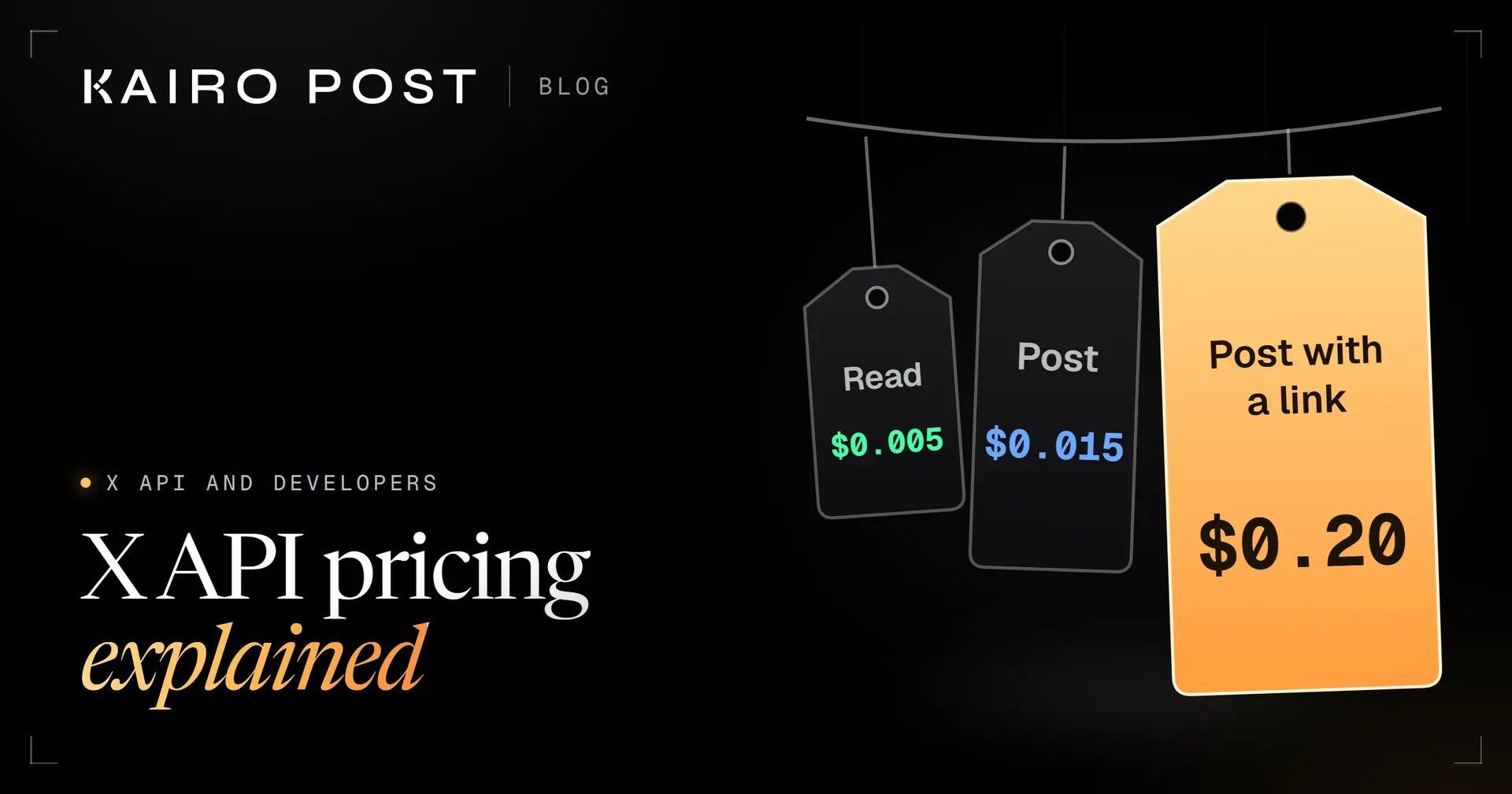
As of 1 October 2026, the X API is pay per use: you buy credits and each request draws them down, for example $0.015 to create a post, $0.20 for a post with a URL and $0.005 per post read. X's pricing page lists no subscription.
Key takeaways
- The X API charges per request for writes and per resource returned for reads, paid from credits you buy upfront.
- A post containing a URL costs $0.20, about 13 times a plain post at $0.015.
- Reading your own data costs $0.001 per resource, a fifth of the $0.005 for other people's posts.
- The same resource is charged once per 24 hour UTC day, and pay per use stops at 3 million post reads per billing cycle.
- Set a spending limit before your first live request, and check X's pricing page before you plan a budget, because prices change.
You want to build on X, or run a tool that does, and you need to know the X API pricing before you write a line of code. The short version: you prepay credits, and every request takes a few fractions of a cent from them.
That sounds cheap, and often it is. A post with a link costs 13 times a plain one, though, and reading other people's posts adds up fast. This page gives you the price list as X publishes it today, four worked monthly estimates with made up numbers, and the habits that keep a bill small.
How does X API pricing work?
X now charges for the API by use. You buy credits in the Developer Console, and each request deducts its price from the balance. X's page says there are no subscriptions, no contracts and no minimum spend.
You start in the Developer Console at console.x.com, and X's getting access guide walks through it: sign in with an X account, accept the Developer Agreement and Policy, create an app and save the credentials, which are shown only once. Then you buy credits.
$0.015
to create a post
X API pricing page, checked 1 October 2026
$0.20
to create a post with a URL
X API pricing page, checked 1 October 2026
$0.005
to read one post
X API pricing page, checked 1 October 2026
Your spending can be capped. X lets you set a spending limit per billing cycle, and the API blocks requests once you reach it. You can also switch on auto recharge, which tops up the balance when it falls under a threshold you pick.
Credits are drawn in real time and you watch them in the console. X's usage page says the console shows usage by endpoint and by app, with the cost and your remaining credits.
X also documents a usage endpoint you can call: it returns how many posts your project and each app read per day, for up to 90 days. It counts posts, not money, so check cost and credits in the console.
What does each X API request cost?
Writes are priced per request and reads per resource returned. The three prices that matter most for a publishing tool are $0.015 for a post, $0.20 for a post with a URL and $0.005 for each post you read.
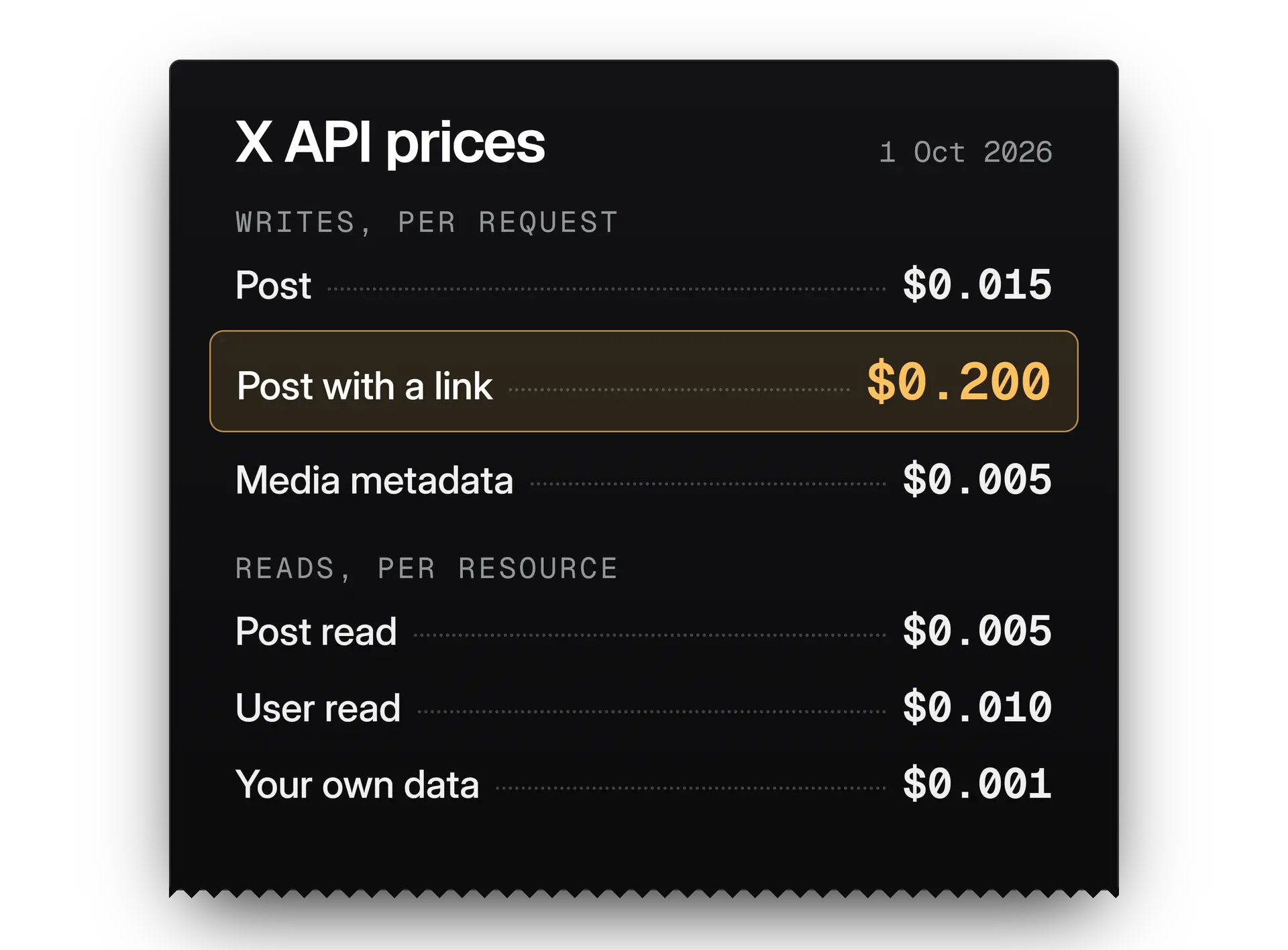
Here is the longer list from X's page, grouped the way X prices it.
| Action you write | Price per request |
|---|---|
| Create a post | $0.015 |
| Create a post with a URL | $0.200 |
| Summoned post | $0.010 |
| Direct Message interaction | $0.015 |
| User interaction | $0.015 |
| Delete an interaction | $0.010 |
| Media metadata (our calculator uses this line for alt text) | $0.005 |
| Bookmark | $0.005 |
| Content management | $0.005 |
| What you read | Price per resource |
|---|---|
| A post | $0.005 |
| A user | $0.010 |
| Followers or following | $0.010 |
| A Direct Message event | $0.010 |
| Lists, Spaces, Communities, Notes | $0.005 |
| Likes, mutes, blocks | $0.001 |
| Your own data (owned reads) | $0.001 |
X also prices counts and trends separately, from $0.005 to $0.010 a request, plus a short list of webhook events. Open the pricing page for those if your project needs them.
What are owned reads?
That is a fifth of the $0.005 charged for other people's posts. If your tool mostly reads your own mentions and followers, you pay far less than a tool that searches the whole platform.
What is free on the X API?
Almost nothing is free, but several things cost nothing. X's pricing page lists no free tier, and the same page calls the model pay only for what you use.
No minimum
A quiet month
X's usage page says you can have months with zero usage and zero cost. There is no monthly fee to keep an app alive.
Deduplicated
Repeat reads in a day
The same resource requested several times within a 24 hour UTC day is charged once.
Listed as free
Some webhook events
X lists some events as free, including post deletions and Direct Messages you send. Others, such as new posts, carry a price.
By classification
Public Utility Apps
Per X's changelog, only apps classed as Public Utility Apps keep free scaled access.
There is also a reward. X returns credits for its xAI API based on what you spend in a billing cycle: nothing under $200, 10% from $200, 15% from $500 and 20% from $1,000. It needs a linked xAI team, and it only helps if you use that API.
Since 2 October 2026 X also gives new paying accounts two one time starter credits: $20 for saving a first eligible payment card, and a match of the first auto recharge up to $50. They are spent before bought credits and expire 3 months after they are granted. The free credits page has the eligibility rules.
What happened to the Free, Basic and Pro plans?
They were replaced. Until recently X sold fixed monthly plans. Pay per use is now the default, and the changelog dates each step.
22 August 2025
Likes and follows leave the Free tier
X removed the like and follow endpoints from the Free tier to combat abuse. Paid tiers were unaffected at the time.
20 October 2025
The pay per use pilot starts
Developers could buy credits upfront and pay per request, with no fixed fee.
6 February 2026
Pay per use launches
X launched the new Developer Console. Public Utility Apps kept free scaled access, legacy Free users got a one time $10 voucher, and Basic and Pro stayed available.
16 April 2026
Owned reads and the post prices
Effective 20 April, owned reads cost $0.001. The changelog states a post costs $0.015 and a post with a URL $0.20, and says following, likes and quote posts through the API were removed from all self serve tiers.
After that, X's developer community announced that legacy Basic and Pro plans are being retired and subscribers moved to pay per use automatically. Read the Pro notice and the Basic notice before you rely on a date.
If a guide you find still sells "the $200 plan" or "the free tier", it is out of date. X's own changelog is the dated record to trust.
How much will you actually pay? Four worked estimates
A small team posting a few times a day pays tens of dollars a month, and most of it goes on posts that contain links. The numbers below are made up to show how the maths works, not to describe any real account.
Each estimate covers 30 days and uses owned reads for your own mentions. You can reproduce all four in the X API cost calculator by tying the sliders to the usage column and ticking the owned reads box.
| Setup (made up) | Usage in 30 days | Estimated cost |
|---|---|---|
| Solo, no links | 1 account, 4 posts a day, 10 new mentions a day | $2.10 |
| Solo, with links | Same, but 1 post in 4 contains a URL | $7.65 |
| Small team | 5 accounts, 4 posts a day each, 1 in 4 with a URL, one media metadata request a day each, 20 new mentions a day each | $40.50 |
| Monitoring tool | 200 other people's posts and 20 profiles read a day | $36.00 |
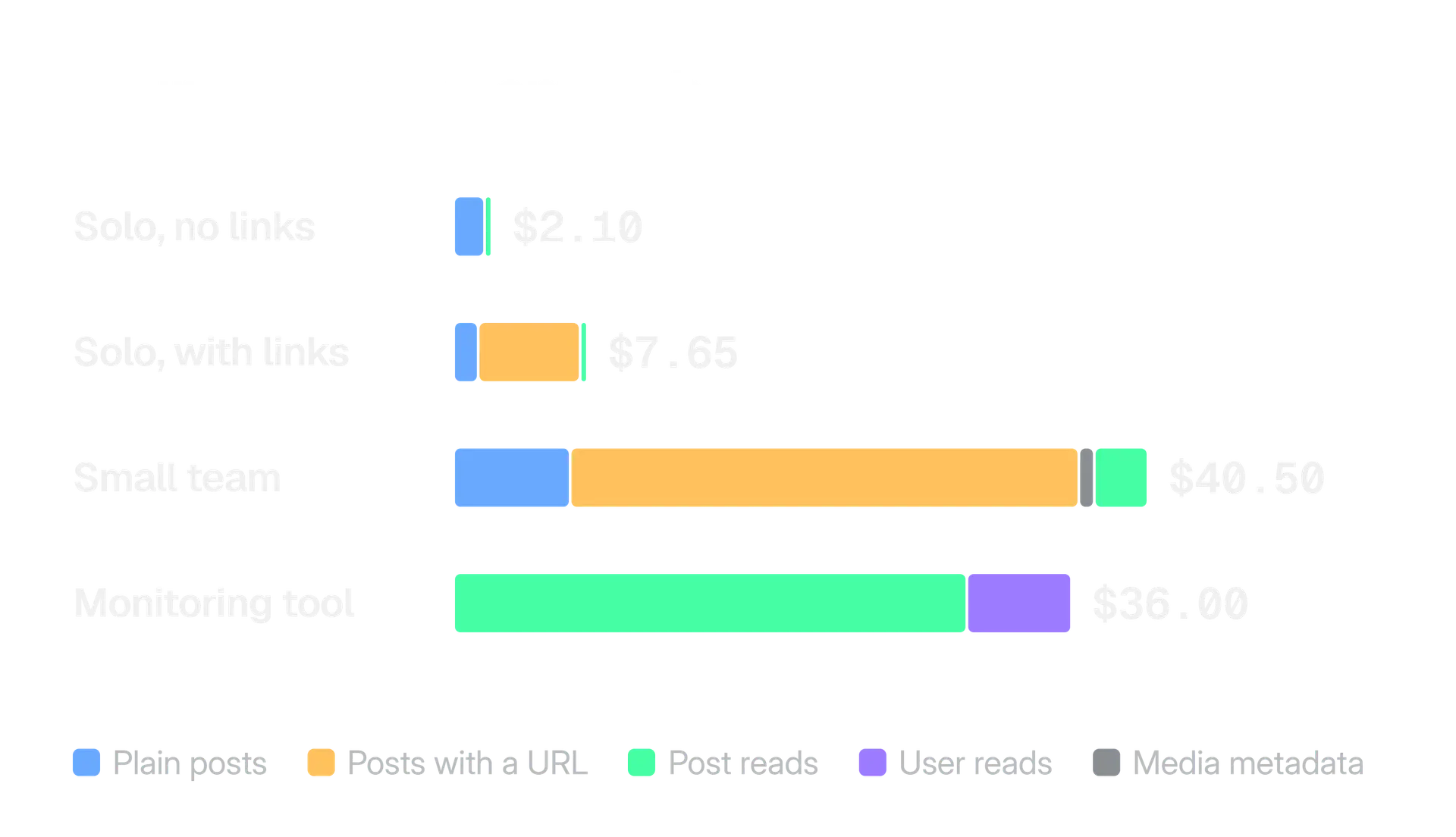
Look at row two. Adding links to a quarter of the posts takes the bill from $2.10 to $7.65. The 30 link posts cost $6.00 of that, which is about 78% of the bill.
The maths behind each estimate
Solo, no links. 4 posts a day for 30 days is 120 posts. 120 × $0.015 = $1.80. Mentions: 10 a day for 30 days is 300 owned reads, 300 × $0.001 = $0.30. Total $2.10.
Solo, with links. 120 posts, of which 30 contain a URL and 90 do not. 90 × $0.015 = $1.35. 30 × $0.20 = $6.00. Mentions $0.30. Total $7.65.
Small team. 5 accounts × 4 posts × 30 days = 600 posts. A quarter, 150, contain a URL: 150 × $0.20 = $30.00. The other 450: 450 × $0.015 = $6.75. Media metadata: 5 × 30 = 150 requests × $0.005 = $0.75. Mentions: 5 × 20 × 30 = 3,000 owned reads × $0.001 = $3.00. Total $40.50.
Monitoring tool. 200 posts a day for 30 days is 6,000 reads, 6,000 × $0.005 = $30.00. 20 profiles a day is 600 reads, 600 × $0.01 = $6.00. Total $36.00.
Media uploads are left out of all four. X's pricing page lists no price for them, so check your console after a test upload. We also assume the Media Metadata line covers alt text, as our calculator does.
The 3 million post read cap is far away. Even if every read were a post at $0.005, 3,000,000 reads would be $15,000 in one billing cycle, which is a long way past any of these.
What drives X API cost?
Four things move the bill: whether a post contains a URL, what you read and whose data it is, how many accounts you run, and any code that repeats work. Of these, links are the one people miss.
A post with a URL is charged $0.20 against $0.015 for a plain one. Divide the two and you get about 13.3, so 13 plain posts cost $0.195, roughly one link post.
X does not define what counts as a URL here, and the page does not explain the gap. So treat any post whose text carries a web address as the expensive kind.
13 times a post
Links
Each post that contains a URL is $0.20. In a thread, only the posts with a link pay that rate.
5 times
Whose data you read
Your own data is $0.001 a resource. Other people's posts are $0.005. Users are $0.010.
Multiplies
Accounts times volume
Writes are per request, so five accounts posting four times a day is 20 create requests a day, before any reads.
Unknown
Loops and retries
X does not say whether a failed request is charged. A bug that repeats a request can spend a lot before you see it.
A thread is several posts, and each one is its own create request. A thread of six with one link in it is five plain creates and one at the link price, which is $0.275 against $0.09 for the same thread with no link.
Do you pay twice to read the same post?
No, not within the same day. X says all resources are deduplicated within a 24 hour UTC day, so the same resource requested several times in one day is charged once.
The window is a UTC day, not 24 hours from your first read. A read at 23:50 UTC and another at 00:10 UTC fall on different days, so they are two charges.
How to keep X API costs down
Most savings come from reading less and linking deliberately. None of them needs clever code.
Read your own data when you can
Your own mentions and followers cost $0.001 a resource, against $0.005 or $0.010 for other people's.
Search broadly just in case
Every post returned is a charge. A wide search that you mostly ignore costs the same as one you use.
Keep the link where it earns its place
Put the URL in the one post of a thread that needs it. Only posts containing a URL pay $0.20.
Add a link to every post by habit
A link on every post turns a $0.015 post into a $0.20 one. Ask if the click is worth thirteen posts.
Then add the safety rails.
Set a spending limit first
X blocks requests once a billing cycle's limit is reached. Set it in the console before your first live request, so a bug cannot run up a bill.
Treat auto recharge with care
It tops up when the balance drops under your threshold, at most once in 5 minutes. Pair it with a spending limit, or a loop could keep refilling itself.
Cache what you have read
Keep posts and profiles you already fetched, so you do not ask for them again tomorrow. Repeats inside a UTC day are free, but a new day is a new charge.
Watch the console for a week
The usage view shows cost by endpoint and by app. It is the quickest way to find the call that costs most.
Rate limits are a separate meter
Prices decide what you pay, and rate limits decide how fast you can go. They are independent, so a request can be cheap and still be refused. X sets a limit per endpoint over a window, usually 15 minutes or 24 hours.
| Endpoint | Per user | Per app |
|---|---|---|
| Create a post | 100 per 15 minutes | 10,000 per 24 hours |
| Delete a post | 50 per 15 minutes | Not listed |
| Upload media | 500 per 15 minutes | 50,000 per 24 hours |
| Mentions timeline | 300 per 15 minutes | 450 per 15 minutes |
| Recent search | 300 per 15 minutes | 450 per 15 minutes |
Per user limits apply when you act with a user token. Per app limits apply when you use a Bearer Token. Go over and the API answers HTTP 429. The reset header tells you when the window ends, so wait until then, and use exponential backoff if errors continue.
Do not try to get around a limit by spreading one job across extra apps. X's Developer Policy says you may not exceed or circumvent rate limits, or register multiple apps for one use case. Our guide to what X lets you automate covers the wider rules. If a tool schedules for you, our guide to scheduling posts on X shows what schedulers do through the API.
When does Enterprise make sense?
Enterprise is for volume the pay per use plan cannot hold. It is custom: you contact X sales and get a quote shaped around your data volume, endpoints and throughput. X's page states no minimum.
| Pay per use | Enterprise |
|---|---|
| Published price per request | Custom quote from sales |
| Capped at 3 million post reads per billing cycle | Custom or unlimited post read volume |
| Start in the Developer Console | Contact sales to apply |
| Console and documentation | Named account manager and priority technical support |
Most teams that publish and monitor a few accounts never come near the cap. Look at Enterprise if you read far more than your own accounts, or you need streams and custom rate limits.
A checklist before you build
Work through this before you write code. It takes ten minutes and saves the surprise.
Before you build on the X API
- Open X's pricing page and note the date you read it.
- List every action your tool takes: create, read, look up users, add media metadata.
- Mark which posts will contain a URL, and price those at $0.20.
- Split your reads into your own data and everyone else's.
- Estimate a month of usage and run it through the calculator.
- Set a spending limit in the Developer Console before the first live request.
- Decide whether to use auto recharge, and with which threshold.
- Check how your code handles HTTP 429 and failed requests.
- Run one real flow on a small balance and compare the console with your estimate.
Your next step is to put your own numbers into the X API cost calculator. It runs in your browser, calls nothing at X and shows each line of the bill, so you can type over any price that has changed.
If you would rather not build this yourself, Kairo Post publishes through the official X API from durable queues. See the publishing feature. And for the wording of the posts themselves, our guide to great X posts is the place to start.
In the product
How Kairo Post does this
Everything above works by hand. Kairo Post does the same work for you, with your approval before anything goes out.
Questions people ask
How much does the X API cost?
Is there a free X API tier?
Do I pay for requests that fail?
What happens when my credits run out?
Can I still buy the Basic or Pro plan?
Does a bigger post cost more?
Sources
Every rule, limit and figure in this post was checked against these on the date shown.
- X API pay per usage pricing and credits, X Developer Platform
docs.x.com · checked
- Usage and billing, X Developer Platform
docs.x.com · checked
- X API changelog, X Developer Platform
docs.x.com · checked
- X API rate limits, X Developer Platform
docs.x.com · checked
- X Developer Policy, X Developer Platform
docs.x.com · checked
- Getting access to the X API, X Developer Platform
docs.x.com · checked
- Enterprise API pricing and custom plans, X Developer Platform
docs.x.com · checked
- Legacy Pro plans moving to pay per use, X Developers community announcement
devcommunity.x.com · checked
- Legacy Basic plans moving to pay per use, X Developers community announcement
devcommunity.x.com · checked
Written by